

Written by Nicky Hughes.
Stained glass is ubiquitous in England; its powerful religious iconography found in all types of buildings of faith, from cathedrals and parish churches, to mosques and synagogues, as well as manifest in striking secular form in civic, commercial, heritage and domestic settings.
However, after the medieval flowering of the art, came the religiously-inspired iconoclasm of the 16th century Reformation and a rapid decline in the use of stained glass.
Two centuries later, stained glass was widely reborn as an artform in England, before finding its greatest expression during the Gothic Revival of Victorian England and then, in the 20th and 21st centuries, by an extraordinary reimagining, both religious and secular.

Reformation and decline
In the 16th century, a religious revolution, the Reformation, swept Europe. Challenging the shared doctrine of the Roman Catholic Church that had existed for centuries, King Henry VIII (1491 to 1547) declared himself Supreme Head of the English Church, giving birth to Protestantism in Britain.

The magnificent decorative expression of Catholicism, such as stained glass and wall paintings, was viewed as superstitious and idolatrous.
Murals in religious buildings were white-washed over. The majority of stained glass windows were destroyed; beautiful coloured glass replaced by plain unadorned glass (including during the later English Civil War period of 1642 to 1651).
The art of stained glass then largely fell out of favour for the next 2 centuries, with far fewer glaziers and glass painters practising their skills.

However, slowly there began to be significant developments in stained glass style:
Figures became more realistic. Windows were approached as a whole canvas, using perspective to create scenes and landscapes spreading across the given space.
This was achieved by largely dispensing with the original use of lead to decoratively define images; instead there were grids of glass squares that were almost entirely enamel-painted, giving a more painterly effect.
Glazed windows in secular buildings became more common.
The use of intricate heraldic shields or coats-of-arms, set within plain glass, were produced in large numbers for the homes of the wealthy.
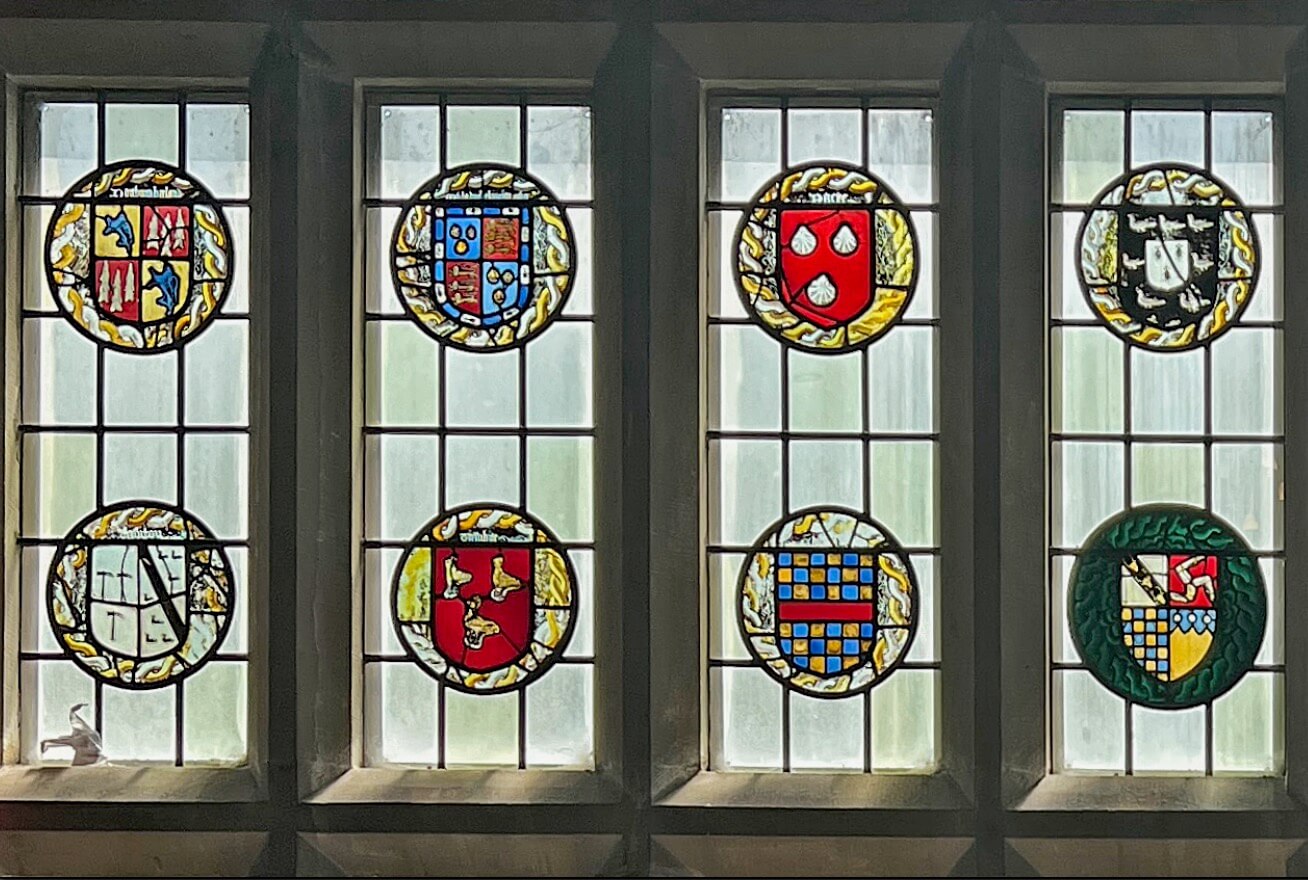
© Tim Green via Creative Commons

In parallel, stained glass was eschewed in high status Baroque architecture of the mid 17th century to early 18th century.
These include London’s City churches built by Sir Christopher Wren (1632 to 1723) and his Painted Hall, below (built 1696 to 1704), the preference being for clear glazed windows to maximise the illumination of their magnificent interiors.

The Victorian age and the Gothic revival
The Industrial Revolution (1750 to 1900) brought seismic change to Britain. Hundreds of thousands of people left the countryside in search of factory work in towns and cities. Craft skills were replaced by mass production.
A Gothic Revivalist movement emerged as a reaction against the resultant ugliness of life and loss of skills. These artists, designers and architects looked back with nostalgia to the beauty of medieval Gothic religious art and architecture, including stained glass windows, seeking to replicate the aesthetic.

This was paralleled by a religious revival across the country. By the start of Queen Victoria’s reign (1837), 134 new churches had been constructed.
Neo-Gothic stained glass became fashionable. Demand soared. Old skills and techniques were relearned. It is estimated over 80,000 new windows were made during the 19th century by many new studios.


Key among the studios was that of William Morris whose founding partners included the artists Edward Burne-Jones (1833 to 1898) and Dante Gabriel Rosetti (1828 to 1882).

_by_William_Morris_%26_Co._(1882).jpg)
William Morris & Co, which also designed furniture, tiles and hand-printed textiles (and still operates today as Morris & Co), created many ecclesiastical stained glass windows, as well as instigating a fashion for highly decorative windows in the private homes of the wealthy.

In the public realm, many towns and cities across the country, including those that had grown wealthy as a result of the Industrial Revolution such as woollen cloth manufacturing Rochdale, often used opulent and traditional stained glass in their town halls, libraries and museums to commemorate history, prominent citizens and local industries, as well as to proclaim civic pride.
However, in parallel, a key new and influential development in the technical creation of stained glass was taking place.
The technique of creating stained glass in the traditional way had hardly changed over the centuries. However, assembling tiny pieces of glass for a delicate intricate design was highly complex, inspiring a major innovation in the 19th and early 20th centuries.


Instead of using lines of lead to join the glass shapes, Tiffany used narrow strips of copper foil wrapped round the edges of the glass, before joining the pieces together with very thin lines of solder.
This copper foil technique, which is widely used to this day in England and elsewhere, allowed for the fine detailing and delicacy that particularly categorises Tiffany stained glass.
Tiffany’s only English church stained glass window dates from 1901.
He was commissioned at the height of his powers to commemorate a family tragedy by Consuelo Yznaga, an American of Cuban descent, the widow of George Montagu, the 8th Duke of Manchester whose family seat was nearby Kimbolton Castle.
Their twin daughters, Lady Jacqueline and Lady Alice both died at a young age, respectively 15 and 20.
Both are pictured in the window kneeling in front of Christ as he reaches out to touch them.

_-_geograph.org.uk_-_8040471.jpg)
via Creative Commons
Early 20th century and the inter-war years
After the First World War (1914 to 1918), many religious and civic institutions across the country commissioned commemorative stained glass windows to remember the appalling loss of life, which included 880,000 from Britain and its then Empire.


The Roman Catholic Church of St Oswald & St Edmund Arrowsmith at Ashton-in-Makerfield, Wigan is considered one of the finest early-20th century churches in England and contains an unrivalled collection of stained glass by Harry Clarke, an artist whose influence on early modernist religious glass was profound.
The church holds 19 intensely coloured stained glass windows. The stained glass in Expressionist style was installed between 1930 and 1937. It represents the largest and most significant collection of his work in the UK. Eight of the windows were installed before Clarke’s early death in 1931, with others completed by his studio. In August 2026, the listed building status of the church was upgraded to Grade II*

The influence of the Arts and Crafts Movement and Art Nouveau on stained glass continued into the early years of the 20th century, not just in churches but in secular and domestic buildings too.
Stained glass was very common, for example, in public houses, especially during the pub building boom at the turn of the century.

In addition, 1920s and 1930s homes in newly-built aspirational suburbia, with their architectural references to vernacular architecture, such as tile-hanging and half-timbering, often had small panels of stained glass in their front doors, some representing sunbursts and idealised rural scenes.
The glamorous decorative style, Art Deco, emerged during the inter-war years of the 1920s and 1930s. The style symbolised optimism for the future and was characterised by strong geometric shapes, as well as streamlined forms.
One of Art Deco’s key features was the creative use of stained glass with bold colours and stylised motifs which appeared in all kinds of building types, from cinemas, theatres and hotels, to factories, shops, transport and private homes.

The inter-war years also saw new stained glass techniques developed, including Dalle de Verre where thick chunks of often vividly-coloured moulded slab glass were faceted, then set in an epoxy resin or concrete matrix, creating structural panels.

Post World War Two
Many stained glass windows had been lost in churches, commercial and civic buildings during the bombing raids of the Second World War.

The post-war rebuilding of towns and cities across the country with modern architecture, meant that stained glass designers could leave the figurative and decorative movements of the past behind and embrace a new abstract aesthetic to decorate buildings; a style that has continued through to today.

The modern age
In the Modernist church of Our Lady of Fatima, Harlow, Essex, 60% of the wall surfaces are made of Dalle de Verre glass, filling the interior with vivid colour and light.
The vibrant abstract symbolic designs were created by Benedictine monk, Dom Charles Norris (1909 to 2004) of Buckfast Abbey, Devon, one of the most important and influential glass artists of the 20th century.

The great memorial east window behind the altar of All Saints Church, Tudeley, Kent commissioned by family to commemorate their daughter Sarah d’Avigdor-Goldsmid in 1963 after she died in a sailing accident, aged 21. The window was designed in abstract style by the Russian-born artist Marc Chagall (1887 to 1985).
The window inspired him to create 11 other vividly-coloured windows for the church, produced over the next 15 years in partnership with master glassworker Charles Marq of Reims, France.

Partly inspired by Chagall, artist David Hockney designed a commemorative window for the reign of Queen Elizabeth II at Westminster Abbey in London, known simply as The Queen’s Window, which was unveiled in 2018. It reflects Queen Elizabeth II’s love of the countryside and in particular Hockney references nature from the East Riding of Yorkshire. The artist sadly died shortly before this blog was written.

Christ Church, Southwark, London, is unusual in having progressive and inclusive stained glass that reflects both the economic boom of the 1980s and the church’s engagement with secular society, bridging the gap between faith and the world of commerce; a legacy from the 1950s when there was a Mission on site, which sent its chaplains to bring Christian ministry into local workplaces.

The modern age has seen extraordinary technical and creative developments in stained glass production and design. One of the most significant contemporary artists who helped revolutionise the medium was Brian Clarke who worked across the globe in both commercial, religious and secular spaces, often at monumental scale, pushing the boundaries of what could be achieved.
Among his pioneering innovations is lead-free stained glass that could span very large areas, breaking the medieval relationship between glass and supportive lead.
Clarke believed in the synthesis of art and architecture, producing structural stained glass and collaborating with some of the world’s most celebrated international architects, from Zaha Hadid to Renzo Piano.


The stained glass of Islam and Judaism in England
From the 8th century onwards, Islamic stained glass with its sacred geometry and patterns (and avoidance of figurative images), has been intrinsic to Islamic architecture round the world.
As with Christianity, the vivid illuminating coloured light symbolises the divine.

Britain’s first mosques were established in 1889. It is now estimated that there are approximately 1,500 in the country, with less than 20% purpose-built, and the remainder formed either from houses or other converted buildings.
The Didsbury Mosque was originally the Albert Park Methodist church (1883) which closed in 1962. Through re-design, it was re-purposed from Christian faith to Muslim, including the addition of the word ‘Allah’ to an original stained glass window.

The first historical mentions of Jewish communities in Britain date from the period following William the Conqueror invasion in 1066. By 1882, there were nearly 50,000 Jews living in England who had arrived via immigration or having fled persecution; their freedom of worship having been officially sanctioned in 1656.
As with the early Muslim communities in England, synagogues were usually in adapted buildings, with the use of stained glass flowering in purpose-built synagogues during the Gothic Revival of the 19th century and burgeoning in the 20th.

The Brighton and Hove Reform Synagogue, East Sussex, is an unusual example in Britain of a building itself being a dedicated memorial to Jewish victims. The abstract iconography of the stained glass windows and the Ark doors, reference the Hebrew Bible and Jewish feasts, as well as representing the historic persecution of Jewish people.

A beautifully written, researched, illustrated article. An inspiration to those who have not yet appreciated this type of artwork.
Love these lengthy articles
Excellent blog. The other figure in the engraving of Henry VIII is almost certainly Archbishop Cranmer, not Cardinal Wolsey.
Very interesting – but one correction: the black & white image that starts the blog shows Henry VIII wit Archbishop Thomas Cranmer. Cardinal Wolsey was dead (died 1530).
Thanks Martin and also Giles for pointing this out- we’ve changed the caption accordingly.
Really interesting. Super article. Thank you. I’m a real sucker for stained glass. It’s such a shame that so much was destroyed in the name of English Protestantism.